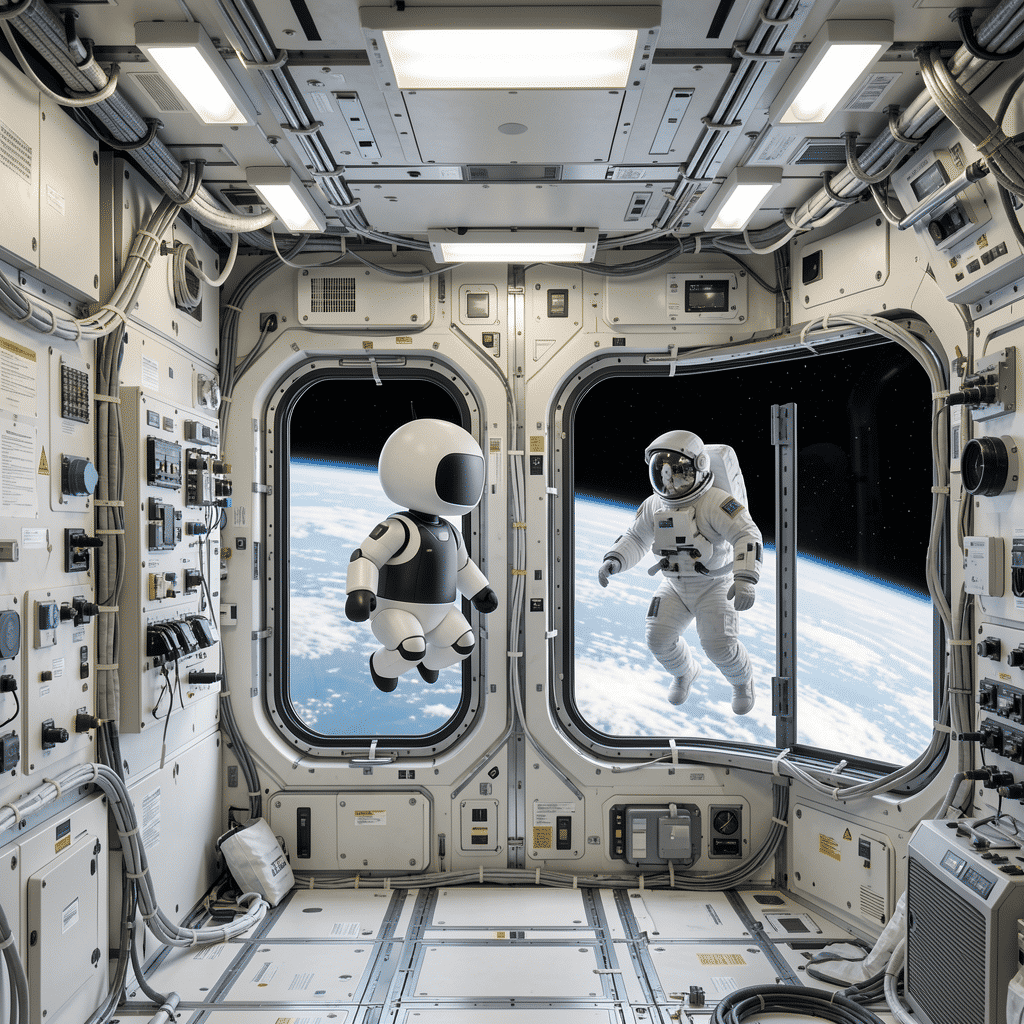
Kirobo, the charming, pint-sized humanoid robot, has become an emblem of humanity's ingenuity in space exploration, particularly in the realm of space communication. Born from a collaboration between the University of Tokyo, Robo Garage, Toyota, and Dentsu, Kirobo was designed to not only break new ground in robotics but also to inspire and connect across the vastness of space.
When Kirobo was launched to the International Space Station (ISS) in August 2013, it was more than just another robotic presence in an extraterrestrial environment. It represented a paradigm shift in how we perceive and implement communication in space missions. Kirobo wasn't merely a machine; it was a personality that astronauts could interact with, providing both technical assistance and emotional support—a crucial element in the psychologically challenging environments of space exploration.
Kirobo's technological advancements were significant. Equipped with speech recognition, natural language processing, and facial recognition technology, Kirobo could engage in complex conversations, understand context, and even adapt its interactions based on the emotional cues of its human counterparts. Its ability to maintain a dialogue was not only a triumph in artificial intelligence but also an evolutionary step in ensuring the mental well-being of astronauts during prolonged missions.
Moreover, Kirobo introduced a new layer of social interaction within the otherwise isolated confines of the ISS. It was a friendly presence, always ready with a word of encouragement or a moment of levity, reminding astronauts of the world waiting for them back on Earth. This capability was particularly groundbreaking because it underscored an often-overlooked aspect of space missions—the importance of maintaining morale and psychological health.
Beyond its interpersonal capabilities, Kirobo played a vital role in advancing communication technology for space missions. Its presence on the ISS allowed engineers to test and refine long-distance communication technologies, paving the way for improved connectivity in future deep space missions. The lessons learned from Kirobo's development and deployment informed enhancements in communication protocols that are essential for the success of missions to Mars and beyond.
Moreover, Kirobo challenged the traditional boundaries of what robots could achieve in terms of human-like interaction. It fostered a reimagining of robotic companions' roles not just as tools or aides, but as integral to fostering a livable space environment. This has profound implications for future exploration as humanity sets its sights on more distant horizons where loneliness and isolation are more pronounced.
In conclusion, Kirobo's journey did not just take it to the stars; it heralded a new era in space communication. By combining cutting-edge technology with a warm and friendly demeanor, Kirobo demonstrated that the future of space exploration will be more interconnected and human-focused than ever before. As we look towards new adventures in the cosmos, Kirobo remains a pioneering figure, reflecting both the spirit of human curiosity and the boundless possibilities of technology.